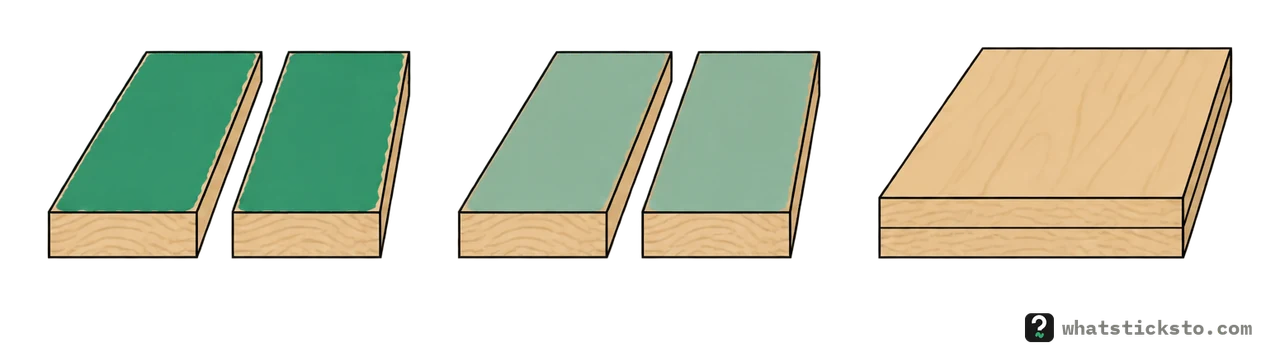
Brush contact cement on both surfaces, let it dry to the touch, then press them together. DAP says the bond is instant and the work can’t be shifted once it makes firm contact.
The method, in DAP’s steps
- Apply an even coat to both surfaces.
- Let it dry: DAP says Weldwood Original dries in 15 to 20 minutes and then looks glossy and feels tacky. If you don’t assemble within 2 to 3 hours, another coat reactivates it.
- Line it up before it touches. For large areas, DAP suggests using dowels.
- Press firmly. No clamps; DAP says it reaches maximum holding strength in 7 days.
Permatex gives the same shape for its contact cement: a coat on both surfaces, wait ten minutes, and make sure the surfaces are in the exact position before joining them.
Solvent or water-based
| Product | Base | Dry and open time | Notes |
|---|---|---|---|
| Weldwood Original | Polychloroprene, solvent | Dries 15 to 20 minutes; open up to 2 hours | Interior or exterior; -40 to 180°F; 72 hours before sun or over 150°F |
| Weldwood Gel Formula | Polychloroprene | Open 1-1/2 to 2 hours | -40 to 180°F |
| Weldwood Nonflammable | Water-based | Dries 60 to 70 minutes; work within 2.5 to 3 hours | At least one surface must be porous |
| Weldwood Original Spray | Aerosol contact cement | Spray both, dry to a tack | 0 to 180°F |
From each product’s data sheet and FAQ. DAP’s 0306/0307 High Heat contact cement is for industrial or professional use only.
What it can’t touch: DAP’s Weldwood Original, Gel and Nonflammable sheets warn against polystyrene foam, and Original and Gel against copper and copper alloys. Original’s sheet also says not for structural use, and that its solvents may stain or damage paint, vinyl and some plastics. Original and Gel carry a “Danger” signal word on their safety data sheets; we’d use them only with good ventilation and no flame nearby.
Contact cement vs rubber cement
Gorilla’s Rubber Cement works differently. Gorilla says to brush it on one surface and join it right away for a bond you can reposition for up to five minutes, or coat both surfaces for a stronger bond. Gorilla rates it for indoor use only, not water resistant, at 50 to 104°F, for paper, fabric, foamboard and photos.
DAP’s FAQ adds a warning for thin materials: thicker brush-grade contact cements can soak through thin foam and fabric and damage them.
Gluing foam or fabric?
Spray adhesive