York, Brewster, Smart Tiles and Art3d rule it out or warn it may not stick. York says its peel and stick paper won’t adhere to textured surfaces, and Brewster lists textured walls as not recommended for NuWallpaper. Tempaper leaves some room: its FAQ lists textured surfaces as not recommended but notes nothing more than an orange peel texture, and its blog says the paper can stick to slightly textured walls after a sample test.
What each maker says about texture
| Product | Textured walls | What the maker adds |
|---|---|---|
| Tempaper peel and stick wallpaper (FAQ) | Listed under surfaces not recommended, with the note “Nothing more than an orange peel texture” | Its install page lists textured surfaces as not recommended too |
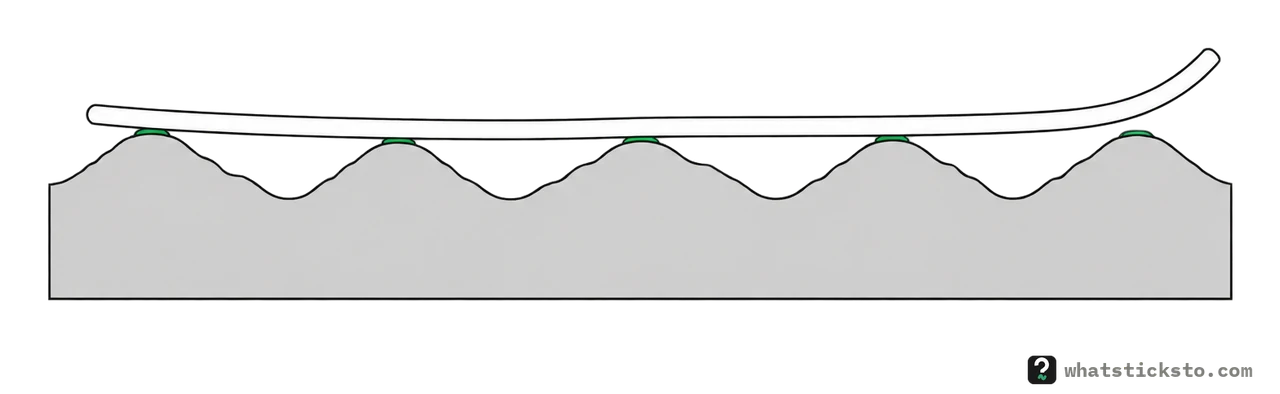
| Tempaper peel and stick wallpaper (texture blog) | Not recommended for textured walls in general; can stick to slightly textured ones | Light orange peel sticks more easily; on popcorn the paper may not stick at all |
| York peel and stick wallpaper | “Products will not adhere to unclean, textured, or nonstick surfaces.” | Clean, dry and smooth walls |
| NuWallpaper (Brewster) | Textured walls are on its not-recommended list | Test in an inconspicuous spot first |
| Smart Tiles (wall tiles) | Not on textured walls, textured wallpaper or textured ceramic tile | Sanding and priming may smooth some walls |
| Art3d vinyl peel and stick tiles | Not on uneven, raised or textured surfaces, stucco or textured wallpaper | Smooth, undamaged surfaces such as painted gypsum |
| Quadrostyle tile stickers | Its 500-micron stickers suit “mild wall textures” | Its 300-micron stickers are for smooth walls |
From each maker’s FAQ, install guide, blog or product instructions. Smart Tiles, Art3d and Quadrostyle make tiles and tile stickers, not wallpaper; we list them because the same question comes up for them.
If you want to try Tempaper on texture
- Order a sample. Tempaper suggests leaving it up for a few days to see how much texture shows through and whether it keeps sticking.
- Clean the wall with a damp cloth and let it dry completely. Tempaper’s install page also suggests a wipe with a 1:1 mix of isopropyl alcohol and water.
- Scrape off large bumps that bulge out from the wall, as Tempaper’s blog suggests.
- Put the sample over the roughest patch of wall, the spot Tempaper says to test.
- Pick a thicker paper, a dark color or busy print, or a textured paper. Tempaper says these hide bumps better.
Tempaper says one of the biggest issues on texture is too much air getting behind the self-adhesive backing. Even when it does stick, Tempaper says the texture may still show through the print.
What Tempaper’s pages say
Tempaper’s FAQ and install page both list textured surfaces as not recommended; the FAQ adds “Nothing more than an orange peel texture”. Its texture blog says peel and stick isn’t recommended for textured walls in general but can stick to slightly textured ones. We’d read that as orange peel at most, and only after a sample passes.
Smoothing the wall first
Smart Tiles says some textured walls may be smoothed by sanding and priming, with the primer left to dry 72 hours before its tiles go on; if you paint instead, it asks for 21 days. For what happens to the paint when the paper comes off, see will peel-and-stick damage paint.
EPA says that if your home was built before 1978, it is more likely to have lead-based paint. If you sand or scrape old paint yourself, EPA says to use its lead-safe work practices, and not to attempt to remove lead-based paint yourself. See epa.gov/lead.
Hanging something on a textured wall instead?
Hanging without drilling