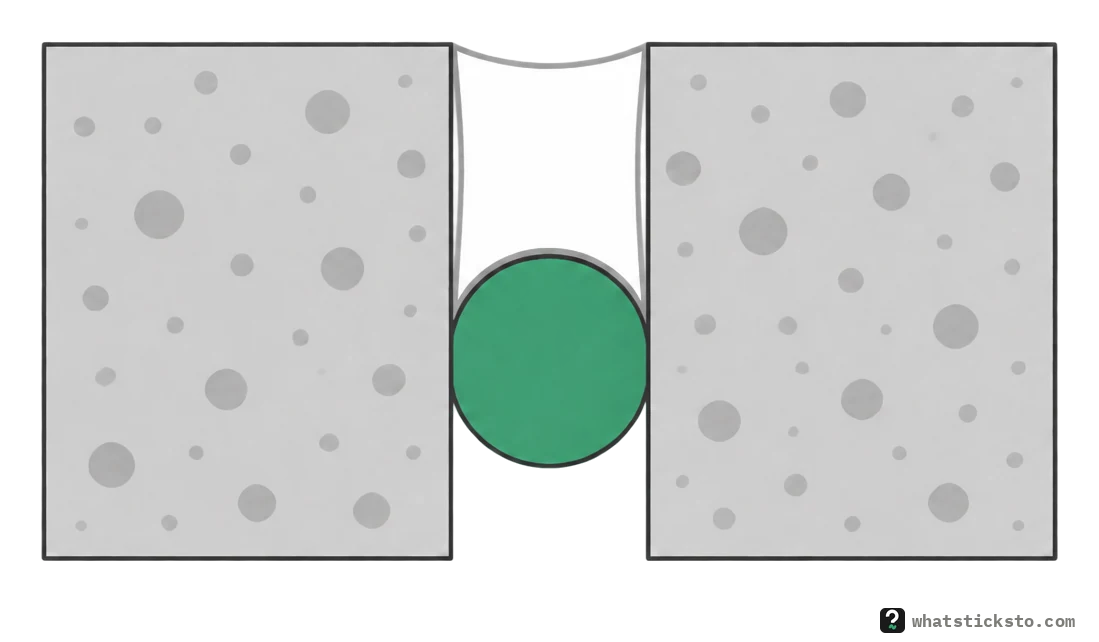
Buy rod a little wider than the joint so it stays put. How much wider depends on the maker: Sika and OSI say 1/8 inch larger for closed-cell rod, and Nomaco says 25 to 50% larger.
Each maker’s rule
| Maker | Rod | Rule |
|---|---|---|
| Sika Backer Rod | Closed cell | 1/8 inch larger than the joint |
| OSI QUAD, QUAD MAX Clear | Closed cell | About 1/8 inch larger |
| OSI QUAD MAX Clear | Soft rod | About 25% larger |
| Nomaco HBR, SOF Rod, OCFoam | Closed cell, bi-cellular, open cell | 25 to 50% larger |
| Frost King Caulk Saver | Poly foam | Slightly larger |
| Bostik Zwaluw (South African sheet) | Closed cell | 50% larger |
| Quikrete | Closed cell | Its own table: 3/4 inch for 3/8 to 1/2 inch joints, 1 inch for 5/8 to 3/4 inch |
From each maker’s own data sheet or instructions.
Joint width to rod size
| Joint width | 1/8 inch rule (Sika, OSI) | Nomaco closed-cell table | Quikrete table |
|---|---|---|---|
| 1/4 | 3/8 | 3/8 | Not listed |
| 3/8 | 1/2 | 1/2 | 3/4 |
| 1/2 | 5/8 | 5/8 | 3/4 |
| 5/8 | 3/4 | 3/4 | 1 |
| 3/4 | 7/8 | 1 | 1 |
| 1 | 1-1/8 | Not listed | Not listed |
The 1/8 inch column is our arithmetic on Sika’s and OSI’s rule. Nomaco’s 3/4 inch rod for a 5/8 inch joint is 20% larger, below its own 25% minimum.
The 1/8 inch rule and Nomaco’s table match through 5/8 inch; Quikrete’s runs larger throughout. We’d go by the sealant’s own data sheet where it gives a rule, as OSI’s does, since it’s that maker’s joint.
How deep it goes
- Half as deep as wide. Sika, OSI, Quikrete and LATICRETE give a 2 to 1 width to depth, and Nomaco calls 2 to 1 the optimal ratio for most sealants.
- Depth limits: Sika and OSI give 1/4 inch minimum and 1/2 inch maximum sealant depth, and Frost King says to leave at least 1/4 inch below the surface for the caulk.
- Press, don’t pierce. Quikrete says not to puncture, stretch or overly compress the rod, and OSI and Loctite say a punctured rod can make the sealant bubble.
- Loctite’s large-gap article says to press the rod level with the surface. Every rod and sealant sheet we read sets it below, and we’d follow those.
Closed cell, open cell or bi-cellular
- Closed cell: Nomaco says it compresses up to about 25% and may out-gas if punctured; Sika says it won’t absorb water. Bostik calls closed-cell foam the most suitable for joints under mechanical or water pressure.
- Open cell: Nomaco says air passes through so the sealant cures faster, but it absorbs water, so it’s mainly for indoors; Sashco says indoor use only. Nomaco says it compresses up to about 75%.
- Bi-cellular: Nomaco says its SOF Rod won’t out-gas when the skin is broken, and compresses 50% or more.
- With silicone, makers split. Backer Rod Mfg. calls open cell the preferred rod for silicone, since air reaches the sealant from behind. LATICRETE recommends closed-cell polyethylene for underwater or continuously wet joints with its silicone.
- Hot-pour sealants: Nomaco’s closed-cell and bi-cellular rods aren’t meant for them, and Backer Rod Mfg. says not to use its Mile High and Titan rods with hot-applied sealants.
Why use it at all
Nomaco lists three jobs: control how much sealant goes in, push it against the sides for adhesion, and act as a bond breaker so the sealant doesn’t stick to the back of the joint. GE calls that last one avoiding three-sided adhesion. Sashco puts rod in any joint 1/4 inch wide and 1/2 inch deep or more.
Is your gap too wide?
Widest gap