Grout fills the joints between tiles, and Custom Building Products’ Polyblend Plus sheet says the tile must be firmly bonded first. Custom keeps its Polyblend Plus grout out of movement joints and changes of plane, where caulk or silicone goes. Over old grout, Custom’s FAQ and LATICRETE’s grout troubleshooting guide both say to dig part of it out first, and no grout maker we read says grout bonds to silicone.
Grout on each surface, by the makers
| Surface | What the makers say |
|---|---|
| Old grout | Dig part of it out first: Custom’s FAQ says 1/2 to 3/4 the thickness of the tile; LATICRETE says at least half the joint’s depth, down to firm grout |
| Silicone or caulk | No grout maker we read covers it; Custom puts caulk or silicone, not grout, in movement joints and changes of plane |
| Wood | No grout maker we read names it as a grout surface; Custom’s FAQ and LATICRETE’s TDS 201 both link flexing wood under the tile to cracked grout |
| Metal edge trim | Schluter says to fill the joint beside its JOLLY profile with grout or setting material |
| Metal, glass or stone tile | Custom says the sand in Polyblend Plus sanded grout can scratch some of them; test a small area |
| Porous or textured tile faces | Polyblend Plus’s sheet says they may need sealing before grouting to prevent staining |
| Plastic | No grout maker we read names it |
From Custom Building Products’ Polyblend Plus Sanded Grout data sheet and FAQ, LATICRETE’s cement grout troubleshooting guide (TDS 201) and Schluter’s JOLLY installation steps.
Regrouting over old grout
Custom’s FAQ answer is to remove 1/2 to 3/4 the thickness of the tile before regrouting. LATICRETE’s grout troubleshooting guide says to remove at least half the depth of the old joint, down to firm and stable grout, then clean it thoroughly. The two measure differently; we’d follow the maker of the grout you’re putting in.
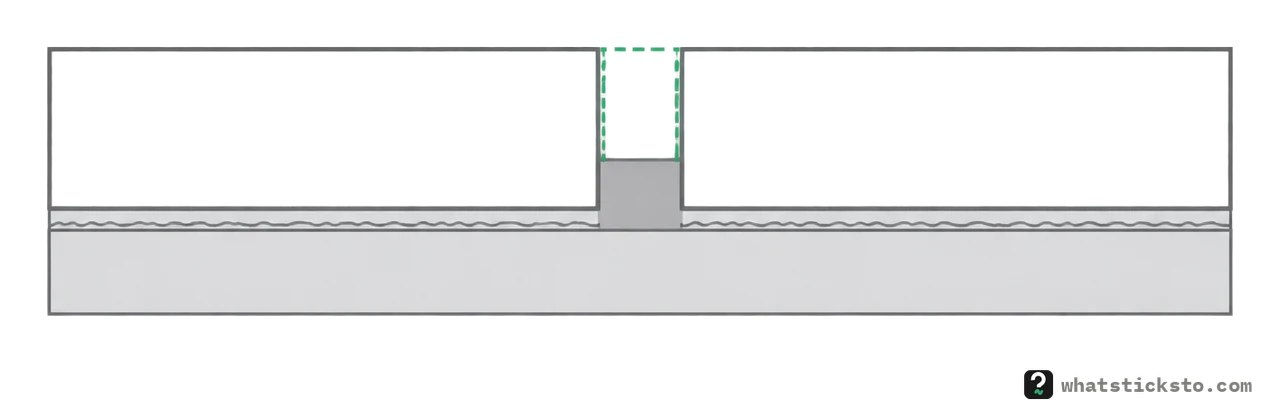
For small gaps, Custom’s FAQ says its Pre-Mixed Grout is for touching up spots where grout is missing in dry areas, and answers no to using it in a shower.
Silicone and caulk joints
We didn’t find a grout maker that says whether cement grout bonds to silicone. Custom’s Polyblend Plus sheet keeps grout out of movement joints and changes of plane and names its 100% silicone sealant or tile caulk for them, and its FAQ says caulk is for joints where settling or structural movement is possible. We’d cut out old silicone before regrouting next to it, then reseal after the grout cures. See caulk vs grout.
Wood under the tile
Custom’s FAQ says not to set tile directly over a flexible surface like plywood, because it tends to distort over time and will cause grout to crack. LATICRETE’s troubleshooting guide lists flexural movement of a wood substrate among the causes of cracked grout joints. For the floor the thinset makers ask for, see thinset on plywood.
Metal trim and metal tile
Schluter’s JOLLY edge profile comes in brass, aluminum and stainless steel. Its installation steps say to fill the joint completely with grout or setting material, and that setting material must be removed immediately, especially from aluminum. Custom says the silica sand in Polyblend Plus can scratch or damage some ceramic, glass, metal, marble or stone tiles, and to test a small area first.
Before you grout
- Custom’s Polyblend Plus sheet says tile must be firmly bonded to a sound substrate, and the setting material cured at least 24 to 48 hours before its cement grout goes in, unless a rapid-setting mortar was used.
- Pull the spacers and clean excess mortar out, so the joints are uniform in depth and width, per the same sheet.
- Porous, rough or textured tile, and some porcelain, may need sealing before grouting, the sheet says, to prevent possible staining.
Custom’s Polyblend Plus sheet says to wear impervious gloves such as nitrile, safety glasses and a NIOSH N95 respirator when handling the grout.
Corners, tub edges and countertops?
Caulk vs grout