Yes, with the right thinset and prep. Custom Building Products’ VersaBond and LATICRETE’s 254 Platinum both list existing ceramic tile as a surface. The old tile has to be firmly bonded and clean: Custom’s VersaBond sheet says to mechanically abrade it, and LATICRETE’s TDS 135 says to scrub it with TSP and rinse. For stick-on tile, see peel-and-stick tile over tile.
Which thinsets list old tile
| Product | Old tile on its sheet |
|---|---|
| VersaBond (Custom Building Products) | Existing ceramic tile (scarified) |
| MultiSet (Custom Building Products) | Existing ceramic tile (scarified) |
| CustomBlend (Custom Building Products) | Existing ceramic tile, listed for the powder mixed with Custom’s Thin-Set Mortar Admix |
| SimpleSet, pre-mixed (Custom Building Products) | Existing ceramic tile |
| AcrylPro mastic (Custom Building Products) | Existing ceramic tile; interior use only |
| 254 Platinum (LATICRETE) | Existing ceramic tile and stone; one of the four TDS 135 names |
| MULTIMAX Lite (LATICRETE) | Existing ceramic tile and stone; one of the four TDS 135 names |
| 253 Gold (LATICRETE) | Ceramic tile and stone, on its substrate list |
| Ultraflex 2 (MAPEI) | Existing ceramic and porcelain tile, quarry tile and pavers (interior only) |
From each product’s technical data sheet, and LATICRETE’s note on existing surfaces (TDS 135).
Prep the old tile
- Make sure it’s solid. LATICRETE says the old tile must be firmly bonded to a rigid substrate, and the floor under it must meet L/360 for tile and L/480 for stone. Custom’s VersaBond, SimpleSet and MultiSet sheets give their steps for well-bonded ceramic tile.
- Clean it. LATICRETE’s TDS 135 says to remove grease, wax and oil, scrub with a TSP solution or electric dishwasher detergent and hot water, then rinse with clean water and let it dry.
- Rough up the glaze. Custom’s VersaBond and SimpleSet sheets say to mechanically abrade well-bonded tile, rinse, and let it dry; MultiSet’s says to use a carborundum stone. VersaBond’s adds that existing glazed tile should be scarified.
- Wear a respirator when you sand. VersaBond’s and SimpleSet’s sheets say an approved respirator should be used, and MultiSet’s recommends one.
- Skim, then comb. LATICRETE says to apply a continuous skim coat of mortar about 1/16 inch thick, then comb more mortar over it with a notched trowel.
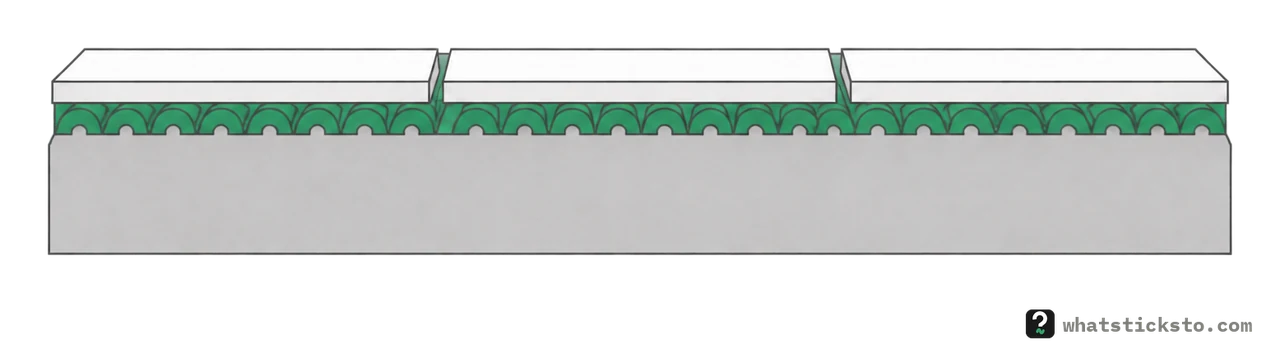
LATICRETE’s TDS 135 steps don’t mention abrading, and it permits and recommends a primer such as its PRIME N’ BOND. We’d do both: clean the tile, then scuff the glaze.
LATICRETE’s two documents
LATICRETE’s note on existing surfaces (TDS 135) recommends 254 Platinum, 254 Platinum Plus, MULTIMAX Lite or MULTIMAX 1 for new tile over old ceramic tile, inside or out. Its 253 Gold data sheet also lists ceramic tile and stone among 253 Gold’s substrates. We’d follow TDS 135 and use one of the four it names.
Mastic over old tile
Custom’s AcrylPro mastic lists existing ceramic tile, for interior use only and not on shower floors. Custom’s FAQ says adhesives can take much longer than 24 hours to dry over dense surfaces such as existing ceramic tile, and that thinset is preferred there, though adhesives will perform.
Grouting the new tile
VersaBond’s sheet says to allow 24 hours before grouting and light traffic. LATICRETE’s 253 Gold sheet says to grout after a minimum of 24 hours curing time at 70°F. MAPEI’s Ultraflex 2 sheet gives 16 to 24 hours before grouting at 73°F and 50% humidity, varying with jobsite conditions, and says tile over nonporous surfaces such as existing tile may need extended setting and curing times.
VersaBond’s sheet says to wear chemical-resistant gloves such as nitrile, and warns that it contains Portland cement and free silica: don’t breathe the dust, and flush your eyes with water for 15 minutes and see a physician if it gets in them.
Covering old tile without thinset?
Peel-and-stick tile over tile