It depends on the mortar. Quikrete’s Mortar Mix is for laying brick, block and stone on clean surfaces, and Quikrete says old joints are repaired with a weaker mortar than the original. Custom’s VersaBond and LATICRETE’s 253 Gold thinsets list concrete and masonry. For wood floors, LATICRETE’s TDS 152 asks for an underlayment over the subfloor, and for steel, its TDS 146 uses metal lath and a mortar coat or an epoxy adhesive.
Mortar on each surface, by maker
| Surface | What the makers say |
|---|---|
| Brick, block and stone | Quikrete Mortar Mix is made for laying them; its Mortar Repair tube adheres to brick, block, stone and concrete |
| Old concrete | Quikrete’s veneer guide says to wash an old foundation and coat it with Mortar Mix or Mason Mix for a good bond; Custom’s VersaBond wants concrete cured 28 days and able to take in water |
| Old mortar joints | Quikrete repairs them with a weaker mortar than the original, and says to remove all loose mortar before using Mortar Repair |
| Wood | No Quikrete line on masonry mortar and wood; LATICRETE’s 253 Gold lists exterior glue plywood (interior only), and VersaBond and 253 Gold say not to bond directly to hardwood, luan or particle board |
| Steel and aluminum | Custom’s VersaBond says not to bond directly to metal, and MAPEI’s Ultraflex 2 sheet lists metal among the substrates not to use it over; LATICRETE’s TDS 146 uses metal lath and a mortar coat, or an epoxy adhesive |
| Painted surfaces | Quikrete’s Concrete Bonding Adhesive isn’t for previously painted surfaces; LATICRETE’s TDS 131 says it’s best to remove paint before tiling |
From Quikrete’s data sheets, FAQ and veneer guide, Custom Building Products’ VersaBond data sheet, MAPEI’s Ultraflex 2 data sheet, and LATICRETE’s data sheets and technical data sheets.
Masonry mortar on concrete and old mortar
Quikrete says its Mortar Mix is a contractor grade mix for laying brick, concrete masonry units and stone, and that the surfaces it goes on should be clean and free of dirt, loose debris, grease and oil for the best possible bond. Its brick veneer guide says to wash an old foundation and coat it with Mortar Mix or Mason Mix so the new veneer bonds.
For old joints, Quikrete’s FAQ says mortar joints are normally repaired with a weaker mortar than the original, and calls Mortar Mix the best choice for joints in masonry walls. Its Mortar Repair, an acrylic in a caulk tube, wants the joint clean and dry with all loose mortar removed, and isn’t for control or expansion joints.
Mortar and wood
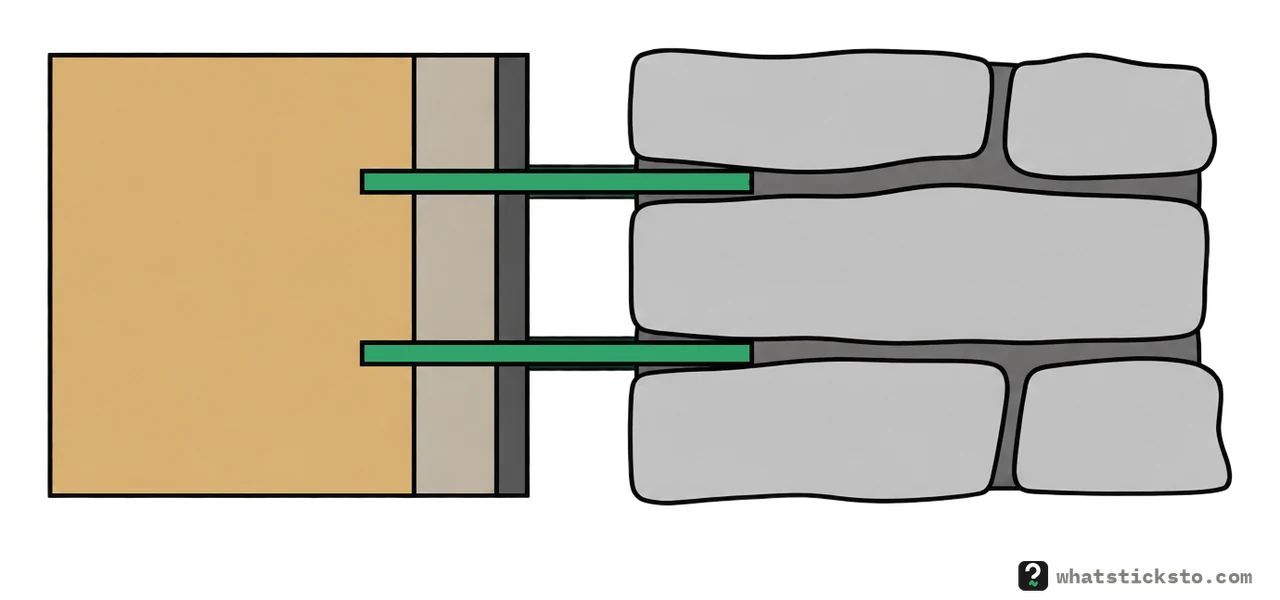
We didn’t find a Quikrete line on masonry mortar bonding to wood. Its brick veneer guide for wood-frame houses uses another method: cover the existing siding with sheathing such as tarpaper, leave a 1 inch air space, and hold the veneer with galvanized metal wall ties nailed through the siding into the studs.
For tile, LATICRETE’s wood-floor note (TDS 152) lists 253 Gold among its mortars over an exterior glue plywood underlayment, and calls hardwood floors, strip wood floors, OSB, particleboard and treated plywood unsuitable for direct bonding. Custom’s VersaBond sheet says not to bond directly to hardwood, luan plywood, particle board or OSB panels. More on thinset on plywood.
Mortar and metal
Custom’s VersaBond sheet lists metal among the surfaces not to bond to directly. LATICRETE’s note on steel (TDS 146) gives two routes: fasten galvanized diamond metal lath over the steel and cover it with a scratch coat of its 3701 mortar, or set tile straight onto rigid, clean, rust-free, unpainted steel or aluminum with its LATAPOXY 300 epoxy adhesive. Quikrete’s FAQ says its stucco products are for use with metal lath.
Painted surfaces
Quikrete’s Concrete Bonding Adhesive, which bonds new concrete, plaster and stucco to old, says not to use it over previously painted surfaces. LATICRETE’s note on painted surfaces (TDS 131) says it’s best to sand, scarify or remove paint before tiling, and that oil-based paint must all come off.
Heat
Quikrete’s FAQ says Mortar Mix and Mason Mix can stand temperatures up to about 300°F, so they can repair the ordinary brick parts of a fireplace, but not the parts made of fire brick.
Quikrete’s safety data sheet for Mortar Mix and Mason Mix says they cause severe skin burns and serious eye damage, and that burns from Portland cement may not cause immediate pain, so you can’t rely on pain to warn you. Its Mortar Mix sheet says to wear impervious gloves such as nitrile.
Gluing to concrete instead?
Wood to concrete